Model-Based Design
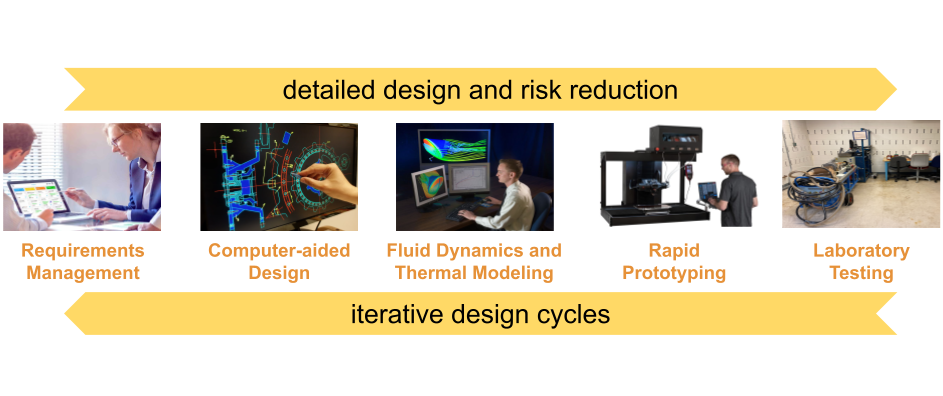
Modern engineering practices have evolved to reduce risk, and deliver specified performance through iterative application of computer-aided design, computational fluid dynamics simulations, rapid prototyping and precision instrumentation.
3D Modelspace
Engines are complex systems of components with many interactions that were traditionally designed by teams of engineers. The number of personnel and time required is minimized through the utilization of 3D tools. The “digital footprint” thus established aids in development of detailed components, review of subsystems (lubrication and cooling, for instance), and external interfaces. The models are critical in transitioning to FEA tools, CFD tools, and digital performance platforms.
Finite Element Analysis (FEA)
The production of 3D models flows directly into the generation of analytical meshes. These meshes are the cornerstone of FEA - they literally define the finite elements within the item. Within the realm of engine design the two most dominant FEA’s are stress and heat rejection. By understanding the contacts and interactions of the components it is possible to observe the mechanical stresses on a piece by piece basis, as well as to predict thermal issues.
Manufacture
Modern manufacturing techniques increasingly rely on access to 3D models. This may include CNC programming, 3D printing of metal and composite components, and generation of mold tooling for foundry operations. These processes tend to be of significant importance in the development of prototype hardware by reducing schedule and cost. SVE Technology and our partners to produce and modify prototypes for laboratory evaluation.
Component Selection and Design
Allocated requirements are realized as material, film and lubricant selections, mechanical designs, and vendor selections. Components are detailed and integrated as 3-dimensional computer models created by SVE Technology and our suppliers.
Computational Fluid Dynamics (CFD)
Complex interaction of fuel, air, and combustion products within the engine cylinder are modeled and simulated to optimize valve, head, and piston design for maximum performance. SVE Technology partners at Dumarey and researchers at Morgan State University study and optimize combustion and turbocharging.
Testing
Engine test cell measurements use dynamometer tests, varying load and ambient condition profiles, and instrumented controllers to collect and verify engine operating parameters. These tests are used to verify design goals are met, and inform refinements in requirements, design, modeling, and future production.